So, you’ve finally embraced your inner bird nerd. Congratulations!
Whether you’re a backyard birder watching chickadees from the kitchen window or a full-fledged binocular-toting field-guide enthusiast, figuring out what you’re looking at is half the fun.
And we live in a pretty remarkable time for birding. Your phone can help identify a bird in your tree faster than you can say, “Is that a sparrow or just another leaf?”
There are plenty of apps that can help you identify birds, listen to their calls, learn more about them, and keep track of what you see. But they don't all serve the same purpose.
Here are some of the most useful ones for Midwest birders—and one that takes a slightly different approach.
1. Merlin Bird ID (Free)
If you download just one birding app, Merlin is a great place to start. I've tried several bird-identification apps over the years, but Merlin is the one I've actually used the most.
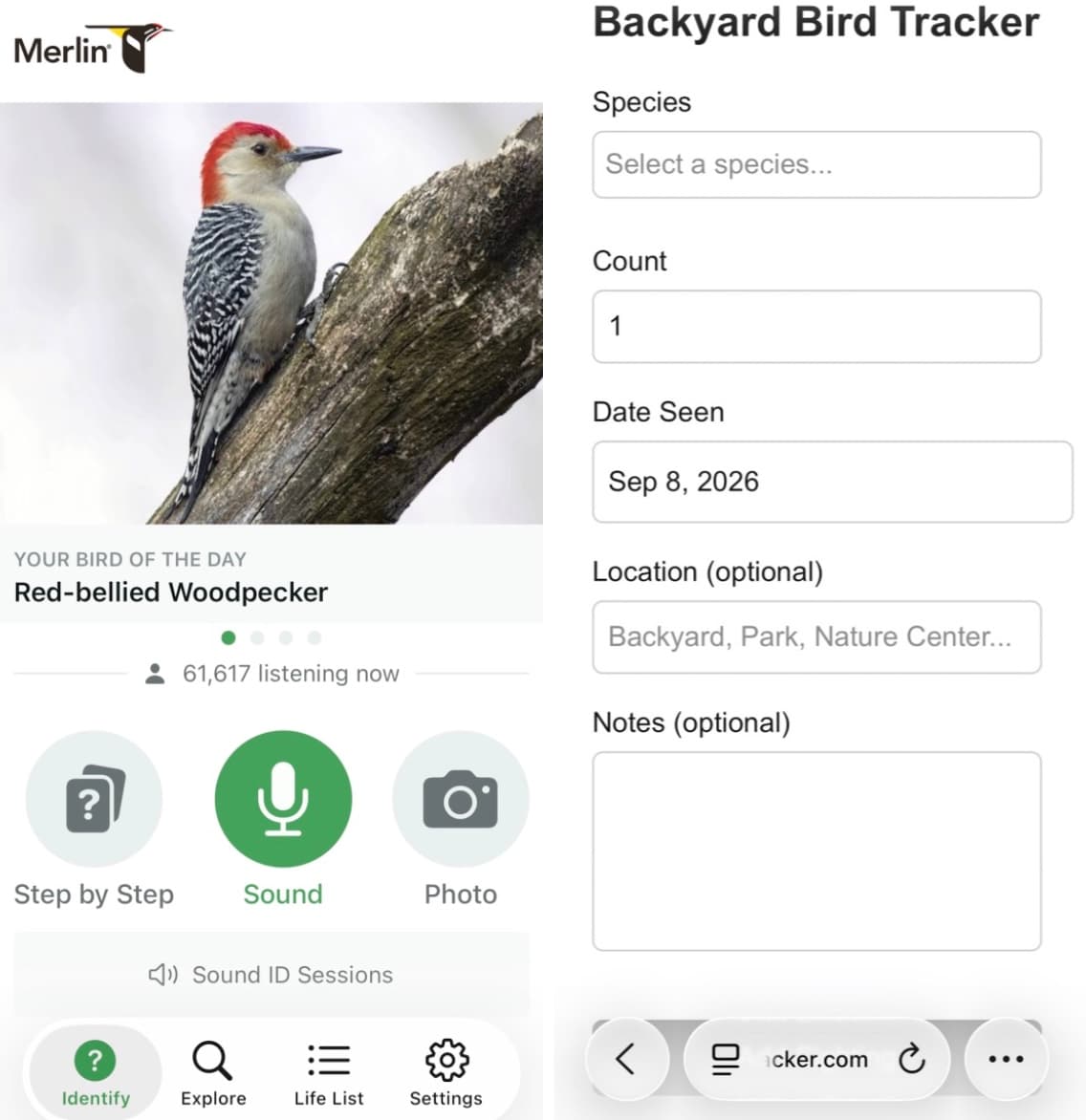
Developed by the bird experts at the Cornell Lab of Ornithology, Merlin is remarkably good at helping you identify a mystery bird. You can answer a few questions about its size, color, and behavior, show it a photo, or use its sound-identification feature.
The app also has regional bird packs, making it particularly useful when you're trying to identify birds you're likely to encounter in the Midwest.
Merlin is especially handy when you're standing in the backyard thinking, “I've seen this bird before, but what on earth is it?”
2. Audubon Bird Guide (Free)
The Audubon Bird Guide is more like having a bird encyclopedia in your pocket, without the weight or the musty book smell.
It includes species information, photographs, range maps, and bird calls. It's useful when you already have an idea of what you're looking at and want to learn more or confirm your identification.
And if you hear an unfamiliar “hoo-hoo-hooo” coming from somewhere in the neighborhood at three in the morning, it might help you determine whether you've got an owl nearby or just a particularly enthusiastic neighbor.
3. iBird Pro (See an app store)
For birders who like lots of information in one place, iBird Pro is worth a look. It provides detailed species information, photographs, illustrations, range information, and other identification clues.
Think of it as a digital field guide with a lot of extra material packed into your phone. It's probably more than a casual backyard birder needs, but that's not necessarily a bad thing. Some people like having all the information available when curiosity strikes.
4. Song Sleuth
Sometimes you know there's a bird nearby, but you can't see it.
That's where sound identification can be useful. Song Sleuth was designed specifically to help identify birds by their songs and calls. Record the sound, and the app analyzes it to suggest possible matches.
Of course, birds aren't always cooperative recording artists. Background noise, wind, multiple birds singing at once, and the occasional car horn can make identification a little more challenging.
Still, learning to recognize bird sounds is one of the most rewarding parts of becoming a better birder.
5. eBird Mobile (Free)
If you want to keep detailed birding lists and contribute your observations to a huge citizen-science database, eBird is the heavyweight in this group.
You can record sightings, keep life lists, explore what other birders are seeing, and contribute observations that can be used by researchers studying bird populations and distribution.
For serious birders, eBird can become an indispensable tool.
But there's an important distinction between recording birds for science and keeping a personal bird journal.
You don't have to turn every bird you see into a formal checklist.
Sometimes you just want to remember that the first Baltimore Oriole of spring showed up in your backyard on a Tuesday morning.
6. Seek by iNaturalist (Free)
If birds are only one of your interests, Seek is worth considering. It's designed to identify all sorts of plants, insects, animals, and other organisms.
Point your phone at something interesting, and Seek will try to identify it.
It's especially handy when your birdwatching session suddenly turns into, “Wait, what kind of butterfly is that?”
7. Backyard Bird Tracker (Free)
And then there's Backyard Bird Tracker (BBT).
Backyard Bird Tracker isn't an identification app—and that's intentional.
BBT is for what happens after you've figured out what the bird is.
You see a bird in your yard. Maybe you recognize it yourself. Maybe Merlin helps you identify it. Maybe you check a field guide or ask another birder.
Then you record that sighting of it in BBT.
Over time, those individual sightings become something more interesting: your own history with the birds around you.
You can see which species visit your yard most often, when you first saw a particular bird, when you last saw it, and how the cast of characters changes with the seasons.
You don't need to identify hundreds of species or keep complicated lists. BBT is simply a way to remember what's happening in your own backyard.
And that's an important distinction.
Merlin can tell you what that bird is. BBT can help you remember that it was there.
You Don't Need All of Them
One of the easiest ways to make birding more complicated than it needs to be is to download six apps and then spend more time figuring out which app to use than watching the birds.
You don't need all of these.
For a beginning backyard birder, something like Merlin for identification + BBT for keeping track of your sightings is a perfectly good combination. (That’s what I use.)
Add a traditional field guide if you like books. Try eBird if you become interested in contributing your observations or exploring birds beyond your backyard. Add a sound-identification app when you find yourself constantly wondering, “Who's making that noise?”
Use the tools that make birding more enjoyable, not the ones that make it feel like homework.
The Most Important App Is the One That Gets You Outside
The Midwest is a birding wonderland, from Bald Eagles soaring over the Mississippi River to tiny warblers passing through backyards during migration.
But you don't need to travel anywhere special to get started.
Grab your phone. Look out the window. Step into the backyard.
If you don't know what you're looking at, that's what the identification apps are for. And once you figure it out, write it down.
Because the really interesting part isn't just knowing that you saw a Northern Cardinal today. It's looking back months or years from now and realizing just how much you've come to notice.
That's when birding stops being something you occasionally do and starts becoming part of how you see the world around you.