So, you’ve caught the birdwatching bug.
Maybe it started when you spotted a bright red cardinal against the winter snow, or maybe you got tired of your neighbor bragging about the rare warbler they saw last spring. Either way, now you want to keep track of your feathered finds.
Welcome to the wonderful world of bird sighting records!
There are several ways to go about this. I have my favorite which I’ll save to the end.
The Classic Notebook
Nothing says "serious birder" like a well-worn field notebook. There’s something satisfying about jotting down your observations by hand—the crisp scratch of pen on paper, the smug feeling of using words like "rufous" and "mottled" correctly.
You don’t need batteries. If you’re the least bit artistic, you can doodle a (terrible) sketch of the bird for future reference. Using a notebook can look very cool and even official when you pull it out in public.
Unfortunately, you often need to do this in a hurry, so a page in your notebook may eventually resemble a grocery list written by a cryptic poet. If you have a coffee cup anywhere in the vicinity, you know where some of your beverage is going to end up sooner or later. And don’t get me started about getting caught in the rain.
The Life List (AKA the Birder’s trophy Case)
If you want to get fancy, start a life list—a running record of every bird species you’ve ever seen. You can keep it in your notebook, a spreadsheet, or even a dedicated app.
Some birders get ultra-competitive with their life lists, traveling far and wide just to check off a single species (looking at you, people who fly to Alaska for a Ross’s Gull).
I’m not one of those people. I do have a Life List, but, as of this writing, it’s only about 39 birds long. I say “about” because it includes a few that I recorded long after the fact of my seeing the bird…and my memory of such things can’t be treated as completely accurate.
And, for the record (pun intended), I do keep it in a spreadsheet.
The Spreadsheet Method
For the more data-driven among us, spreadsheets offer a structured way to record bird sightings. With columns for date, location, species, behavior, and that all-important "Did I totally misidentify this bird?" category, you can create a detailed record of your birding adventures.
It’s organized, searchable, and customizable, if you know what you’re doing. You can see patterns over time, and it might make you feel more like a scientist (or geek).
But it’s not very romantic and can be harder to access when you’re knee-deep in a marsh. Setup can be a problem, especially if you’re not all that familiar with spreadsheets in the first place.
Birding Apps: Because It’s the 21st Century
If you’d rather leave pen and paper in the past, birding apps like eBird, Merlin Bird ID, or Seek can help you log sightings digitally. These apps often have the bonus of connecting you to a community of birders, providing ID help, and even contributing to citizen science.
As long as your phone has a charge, these apps can always be at your fingertips. Merlin is great for identifying birds. eBird is fantastic for contributing sightings and exploring what's being seen in your area.
For many of us, they can be overkill though. I personally think eBird is too complicated for what I need.
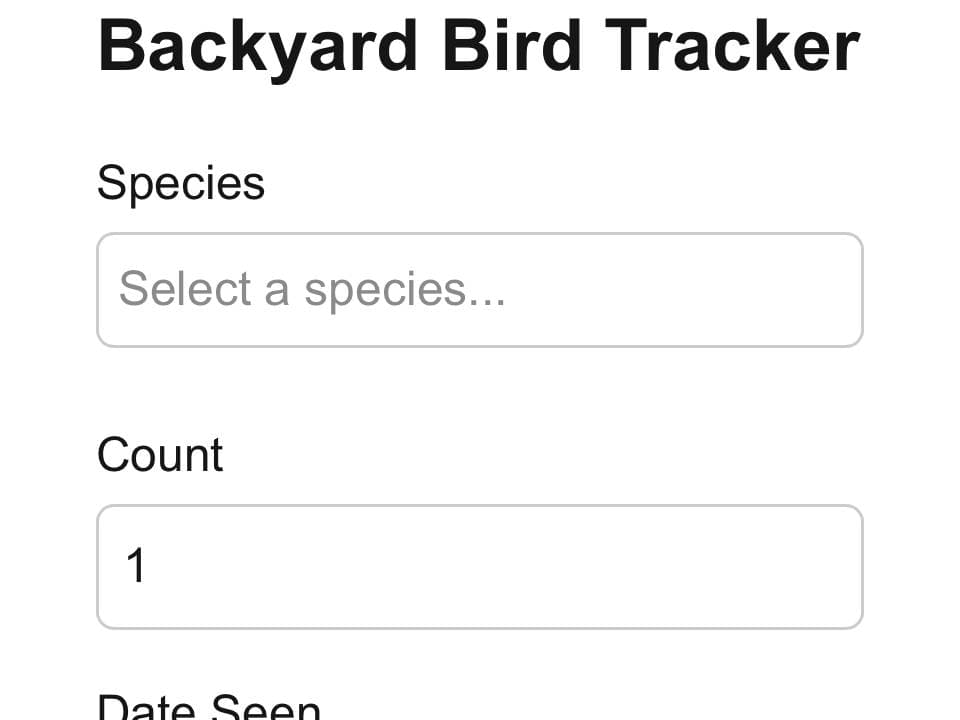
If your goal is simply to remember the birds that visit your own backyard over time, a personal journal can be a satisfying alternative. That's exactly why I created Backyard Bird Tracker—to make it easy to record everyday sightings and look back at the story of your own backyard.
The Takeaway
No matter how you record your bird sightings, the most important thing is to enjoy the process. Whether you’re scribbling notes in a mud-streaked notebook, triumphantly checking a rare bird off your life list, or making quick notes in an app before the bird flies away, you’re building a personal history of your birding adventures.
If you've ever forgotten when a favorite visitor first appeared—or wondered whether that House Wren really came back this spring—keeping a simple bird journal can make those moments easier to remember. That's what Backyard Bird Tracker was designed to do.
Maybe someday, you’ll even reminisce about that rare warbler sighting!