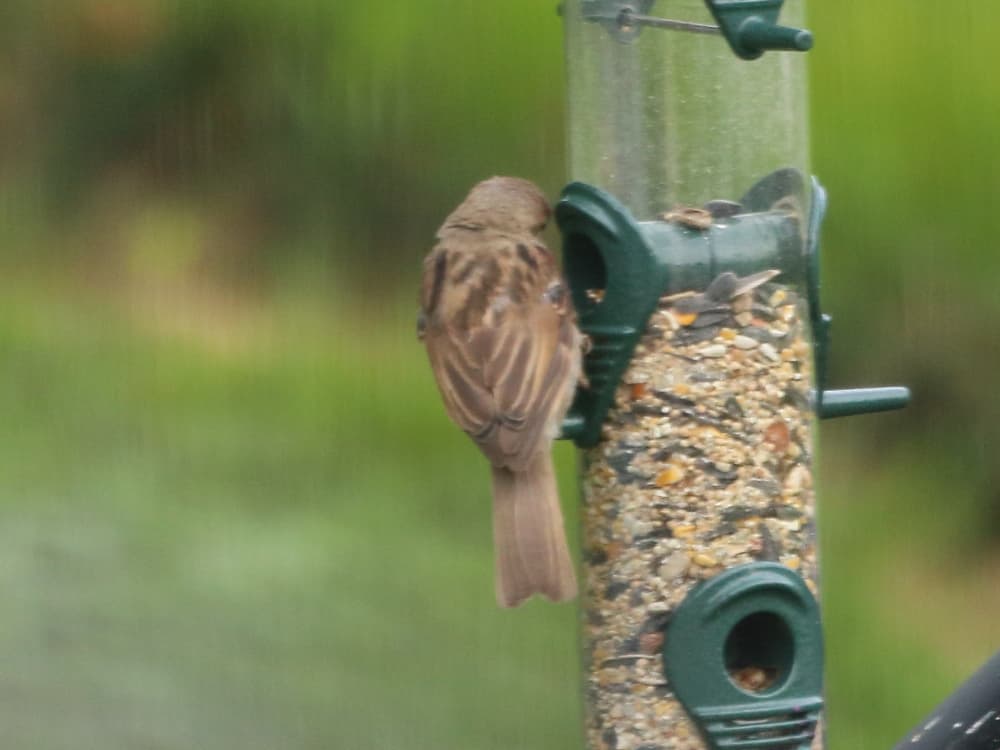
“I think it’s a House Finch, but it could be a Chipping Sparrow.”
“From this distance, I can’t tell if it’s a Bald Eagle or maybe a Turkey Vulture.”
As birdwatchers, we’ve all been there. There’s a bird that looks kinda familiar, in fact, maybe too familiar sometimes, and you just can’t decide.
Or, it might be a species you’ve never seen before and really have no idea what it could be. Whatever the case, let’s break this predicament down into smaller, more manageable ideas to help you identify that tricky feathered friend. You’ll soon see that you don’t have to be an expert to ID a bird, you just have to take time to notice a few things.
Start with the Bird, Not the Book
When trying to ID that mystery bird, before you run for your field guide, pause for a minute and really look at the bird.
- Where is it?
- What’s it doing?
- How big does it seem?
- What colors or patterns stand out?
- What’s its overall shape?
If it’s not by a larger body of water than your bird bath, it’s probably not a heron.
If it’s eating from your feeder, it’s probably not a robin.
If it’s bigger than a breadbox (assuming you’re old enough to know how big that is), it’s definitely not a hummingbird.
If it’s bright red, it’s not a Blue Jay or a goldfinch.
If it doesn’t have a crest, it’s probably not a Northern Cardinal.
Size and Shape Are Surprisingly Useful
Sometimes we focus too much on the color of the bird. While that can obviously be helpful, take in its size and shape too.
When looking at overall size, don’t try to use a mental tape measure. Just compare it to common birds you already know. Is it about the size of a sparrow, a robin, or a crow? Smaller? Bigger? Somewhere in between?
If you’re close enough or are using binoculars, can you see the shape of its bill? That can be really helpful in distinguishing, say, finches from sparrows.
Does it have a boat tail, like a Common Grackle? Does the tail come to a single point or does it (literally) dovetail?
Look at the Obvious Markings
Let’s assume you’ve now got it narrowed down to two, maybe three, possible species. Next see if there are any obvious markings (sometimes called “field marks”) that will help you get it down to one and only one choice.
Are there any of these features that stand out on your bird?
- eye stripe
- eyebrow
- wing bars
- breast markings
- throat color
- tail pattern
- distinctive patches
Not that a bird has to have all, or even several, of these. Many times just one will do. Don't Forget Behavior
What’s the bird doing? Is he hopping on the ground, like a robin? Is he upside down from your vantage point (nuthatch) or creeping along a tree trunk (treecreeper)?
Maybe he’s hovering over some flowers, like a hummingbird. Does he quickly flit back and forth from a perch to a feeder, like a chickadee?
Behaviors like these can be an identification clue just as much as appearance.
Location and Habitat Matter
A bird sitting on your backyard feeder doesn’t necessarily give you the same set of possibilities as a bird wading in a marsh.
So note, in general, where your bird is sitting or walking or flying - backyard, woodland, wetland, or somewhere else? Is he at the feeder, on the ground, or in a tree?
Where are you geographically? In the Midwest, along the east or west coast, or in the mountains? This is where a regional field guide can often be helpful.
Choosing an Identification Guide
There are several different types of ID guides: printed (worldwide, national, regional), apps, and other online guides.
The printed guides are great for browsing and comparing birds nearly side-by-side. There’s still something of an advantage in many cases in having a paper copy in your hand, as opposed to an electronic version on some device.
That said, there are some excellent apps for when you do have a phone handy. (And, let’s be honest, we virtually always have our phones handy, right?) These apps are probably best at doing the work for you by identifying birds using sounds and images, as opposed to using your own eyes, ears, and memory.
The other online guides help you learn more details about the habits, movements, the lifetimes, and such of the species you’re interested in.
The point here is this: Use the guide that you think will help you the most in a given situation. It’s not always that app in your pocket.
What If You're Not Sure?
When trying to identify an unknown bird, “I think it’s a House Finch” is a perfectly acceptable observation. Just jot down (or type): “House Finch - probably” and move on.
With more experience, this identification process gets easier and easier. Maybe you’ll be able to come back later and change “probably” to “definitely”.
A Little Practice Goes a Long Way
Here’s a simple challenge for you:
The next time you see a bird you don't recognize, don't immediately look it up. Watch it for 30 seconds and write down at least three things you notice.
Before you look it up, try notice most of these things:
- Size
- Shape
- Color/pattern
- Behavior
- Where and when you saw it
Then use the guide that fits best.
The goal here isn't to become someone who can instantly name every bird - though kudos if you can someday. It's to become someone who looks a little more closely than they did yesterday.